Lorem ipsum dolor sit amet, consectetur adipiscing elit, sed do eiusmod tempor incididunt ut labore et dolore magna aliqua. Ut enim ad minim veniam, quis nostrud exercitation ullamco laboris nisi ut aliquip ex ea commodo consequat. Duis aute irure dolor in reprehenderit in voluptate velit esse cillum dolore eu fugiat nulla pariatur.
Block quote
Ordered list
Unordered list
Bold text
Emphasis
Superscript
Subscript
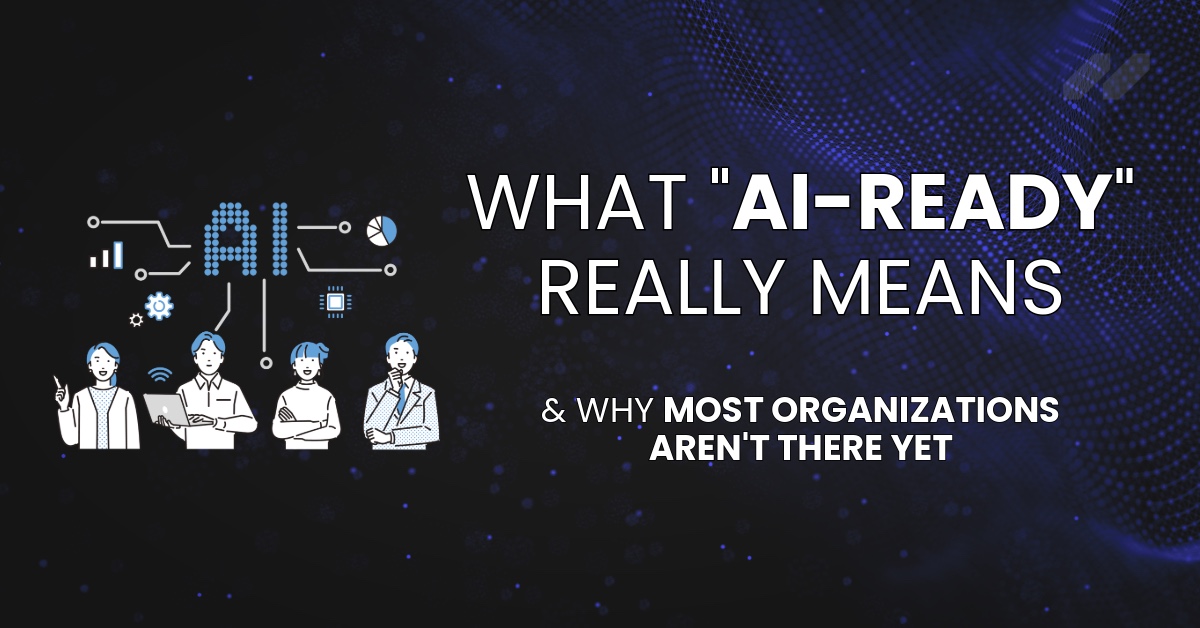
When organizations talk about being AI-ready, the conversation usually turns to models, tools, or talent.
But in practice, AI readiness comes down to something much simpler:
Can your teams easily find, trust, and safely use the data you already have? For most organizations, the answer is not yet.
If any of those break down, AI slows down or stops entirely.
That’s why so many AI initiatives struggle to move beyond early pilots, even when the technology itself is solid.
Here’s what’s happening behind the scenes in many organizations.
AI teams are eager to move fast. Security teams are responsible for reducing risk. Data teams are stuck in the middle, trying to make everyone happy.
And the friction usually shows up around questions like this. Can you answer them?
When those questions don’t have clear answers, progress slows. Access gets delayed. Or projects get scaled back “for now.”
This isn’t a tooling problem. It’s a data readiness problem.
Most organizations already have more data than they know what to do with.
The problem is that the data AI teams can easily access is often:
AI, on the other hand, works best with stable, point-in-time datasets—data that reflects reality at a specific moment and can be trusted later.
That kind of data exists. It’s just not where most teams think to look.
Every day, organizations create exactly the kind of datasets AI teams want. How?
They’re in your backups.
Cloud backups contain:
From an AI and analytics perspective, that’s incredibly valuable. From an operational standpoint, it’s rarely used.
Backups have traditionally been treated as untouchable.
Most teams associate them with:
And to be fair, that mindset makes sense. Backups haven’t historically been searchable or easy to inspect. Accessing them often meant restoring data, copying it, or creating new infrastructure.
That introduces risk, cost, and complexity, so teams avoid it altogether.
The result is a strange gap: some of the most trustworthy data an organization owns remains invisible to the teams that need it most.
When teams say they want to be AI-ready, what they’re really asking for is confidence.
Confidence that:
In practical terms, that means data must be:
Without these, AI teams either wait—or work around controls, which creates even bigger problems later.
A growing number of organizations are starting to rethink backups—not as dormant insurance policies, but as a governed data foundation.
When backups become searchable and classifiable:
Most importantly, teams stop being forced to choose between speed and safety.
If your AI initiatives feel harder than they should, it’s worth asking a simple question:
Do we actually have AI-ready data—or just a lot of data?
In many cases, the missing piece isn’t new pipelines, new platforms, or new models. It’s visibility and trust in the data you already store.
Backups won’t solve every AI challenge. But ignoring them often means overlooking the most complete, reliable datasets you own.
That’s why more teams are exploring how to activate backup data, securely and intentionally, as part of an AI strategy.
Hypershift and Eon are hosting a joint session on what it takes to make cloud backups searchable, governable, and AI-ready without copying or moving data or building new pipelines.
➝ Sign up for the Webinar here.
➝ Find out more about our AI Workshops here.


.jpg)