Lorem ipsum dolor sit amet, consectetur adipiscing elit, sed do eiusmod tempor incididunt ut labore et dolore magna aliqua. Ut enim ad minim veniam, quis nostrud exercitation ullamco laboris nisi ut aliquip ex ea commodo consequat. Duis aute irure dolor in reprehenderit in voluptate velit esse cillum dolore eu fugiat nulla pariatur.
Block quote
Ordered list
Unordered list
Bold text
Emphasis
Superscript
Subscript
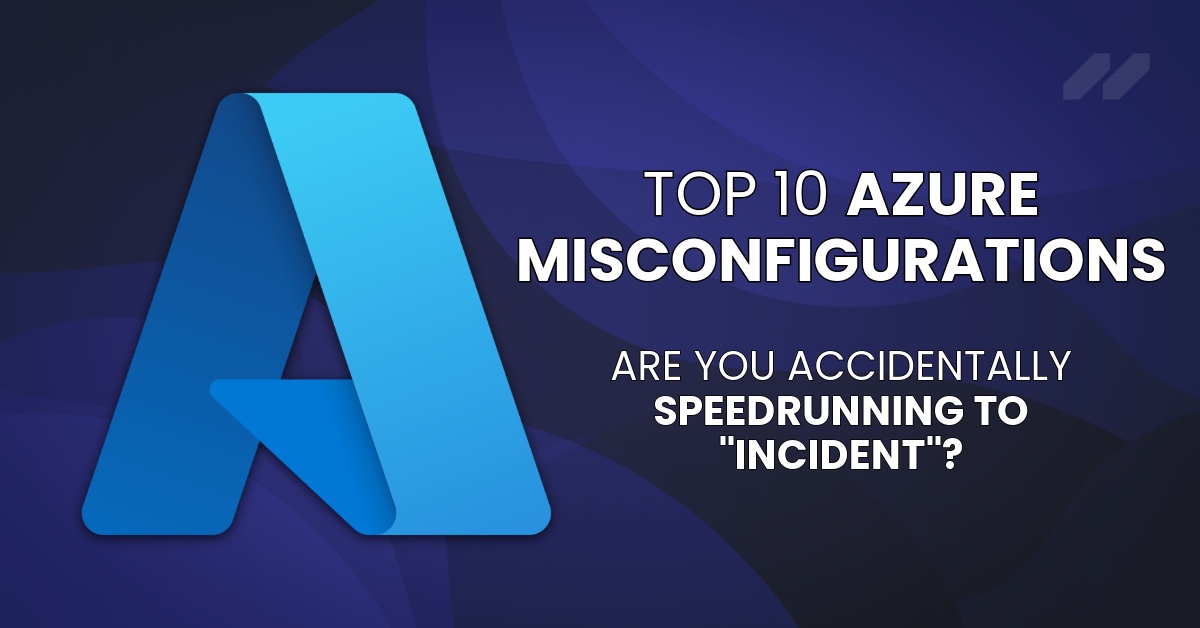
Most breaches aren’t Ocean’s Eleven; they’re unlocked doors with good lighting. Azure is powerful, but defaults and drift can turn “should be fine” into “why are we on the news?” Here’s the pragmatic tour of the ten misconfigurations we fix most: Plus how to avoid starring in your own post-mortem.
If you're looking for more guidance, check out our Azure Consulting services.
What goes wrong: Admins, service accounts, or legacy protocols bypass MFA. Password sprays don’t need creativity when your door says “push.”
Instead, enforce MFA for all users; require phishing-resistant methods (FIDO2 or number matching) for privileged roles. Backstop with Conditional Access (device compliance, location, sign-in risk) so “MFA” isn’t a checkbox; it’s a context.
Takeaway: If a service account can log in from a coffee shop at 3 a.m., that’s not “flexibility,” it’s foreshadowing.
What goes wrong: NSGs with 0.0.0.0/0 inbound. Bots find you faster than your monitoring does.
Do this instead: Close public management ports. Use Azure Bastion or Defender’s Just-in-Time (JIT) VM access for time-bound openings.
Reality check: “We’ll open it for a day” is cloud’s version of “I’ll just hit snooze once.”
What goes wrong: Wide-scope “Owner/Contributor” grants inflate blast radius. Stale service principals linger.
Do this instead: Scope roles to resource groups; use custom roles when needed. Enable Privileged Identity Management (PIM) for just-in-time elevation and approvals.
Gentle nudge: If everything is critical, nothing is. Least privilege is a lifestyle, not a vibe.
What goes wrong: Public blob/container access left on “for testing,” which apparently lasts forever.
Do this instead: Disable public access at the account level, put storage behind Private Endpoints, and enable versioning/immutability where data matters.
Truth: If a sensitive file needs to be world-readable, either it’s not sensitive—or your process isn’t.
What goes wrong: Soft delete off, purge protection off, secrets deleted “temporarily” during an incident… and then actually gone.
Do this instead: Turn on soft delete + purge protection everywhere; access vaults via Private Endpoints; log to Log Analytics.
Unfun fact: Forensics without an audit trail is just storytelling.
What goes wrong: No Diagnostic Settings, fragmented logs, zero-retention strategy.
Do this instead: Standardize Diagnostic Settings to Log Analytics (and/or Event Hub), align retention with ops/compliance/security, and make sure your SIEM (e.g., Microsoft Sentinel) actually ingests what you think it does.
Practical note: A high-severity alert that emails a dead mailbox is not “managed risk.”
What goes wrong: Secure Score flatlines, Azure Policy reports gather dust, and drift becomes culture.
Do this instead: Treat Secure Score as a KPI; assign the Azure Security Benchmark (ASB) initiative at management-group scope; review deltas weekly; auto-remediate when possible.
Reality check: If you only check posture before audits, you’re practicing compliance theater.
What goes wrong: Azure SQL, Storage, or Cosmos DB left with PublicNetworkAccess = Enabled.
Do this instead: Disable public network access, use Private Endpoints, and restrict egress with service tags and UDRs to approved inspection points.
Takeaway: “It’s behind a strong password” is not a network architecture.
What goes wrong: Backups are configured but never tested; RPO/RTO are inspirational quotes, not numbers.
Do this instead: Use Azure Backup for point-in-time restores and Azure Site Recovery (ASR) for cross-region DR. Run quarterly restore drills and document time-to-recover.
Realtalk: A backup you’ve never restored is fan fiction.
What goes wrong: Orphaned resources, mystery spend, finger-pointing during incidents.
Do this instead: Enforce tags via Azure Policy (Owner, App, Environment, CostCenter, ComplianceTier). Use management groups to separate Dev/Test/Prod and inherit policy cleanly.
Pro tip: Cost accountability is a side effect of architecture discipline, not a spreadsheet miracle.
These ten fixes aren’t fancy. And that’s the point. Close the obvious doors, wire the signals, and shrink the blast radius so issues become tickets, not headlines. If you want a sprint-sized session mapping these to your estate, grab a quick chat here:


.jpg)