Lorem ipsum dolor sit amet, consectetur adipiscing elit, sed do eiusmod tempor incididunt ut labore et dolore magna aliqua. Ut enim ad minim veniam, quis nostrud exercitation ullamco laboris nisi ut aliquip ex ea commodo consequat. Duis aute irure dolor in reprehenderit in voluptate velit esse cillum dolore eu fugiat nulla pariatur.
Block quote
Ordered list
Unordered list
Bold text
Emphasis
Superscript
Subscript
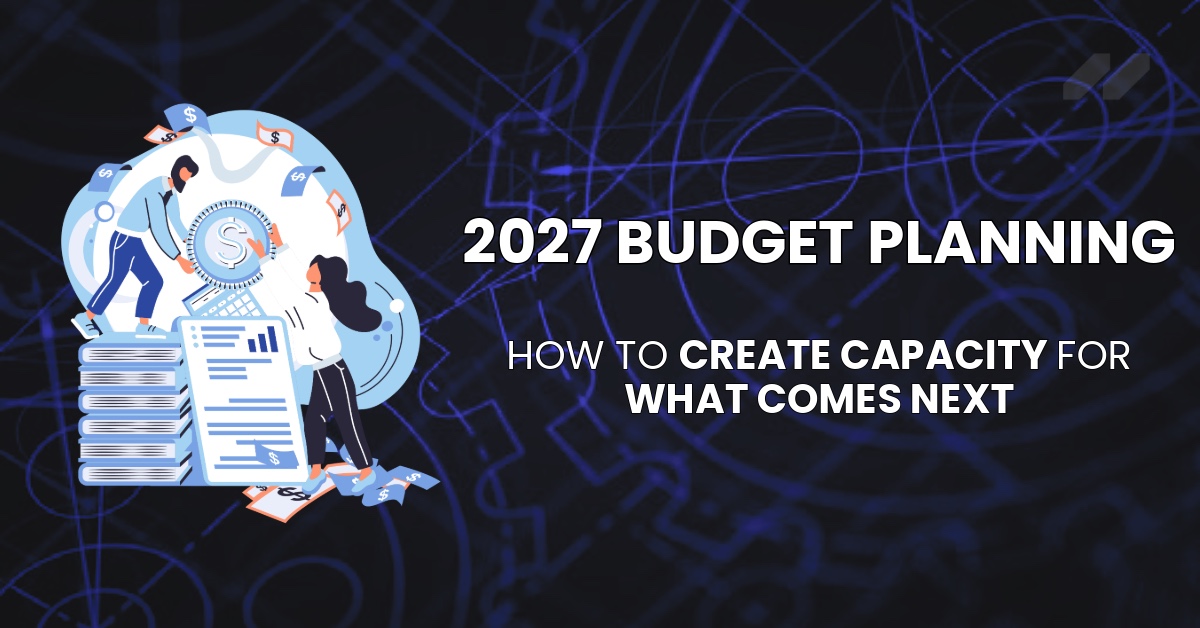
IT budget planning for 2027 is less about finding another round of indiscriminate cuts and more about creating capacity for the priorities the business cannot ignore. Start by challenging inherited costs across cloud, licensing, infrastructure and security. Give AI initiatives a defined production gate. Budget for the resilience required when AI becomes part of an operating workflow. Then explain the plan to the C-suite in terms of business outcomes, financial tradeoffs and risk.
The goal is not to spend less everywhere. It is to stop spending where the investment is no longer earning its place.
This article highlights the most important decisions to get you started, but we know there is a lot more to get to the finish line. That's why we created the full 2027 IT Budget Playbook that includes industry benchmark ranges, a complete budget-rebalancing framework, role-specific planning questions, the AI production gate, an AI resilience checklist, three examples and a bonus budget workbook and calculator. It's a free gift from the expert engineers at Hypershift, and you can grab it below.
Download the full 2027 IT Budget Playbook
IT leaders are still expected to modernize infrastructure, strengthen security, improve resilience, support AI adoption and keep the business moving. What has changed is the assumption that every new priority will arrive with new funding.
Increasingly, the money for the next initiative has to come from somewhere inside the existing budget.
That makes 2027 planning an exercise in allocation, not just reduction. The important question is no longer simply, "Where can IT cut?" It is, "Where can we create enough capacity to invest in what matters next?"
That distinction matters. Broad cuts can make a spreadsheet look healthier while increasing operational risk, delaying necessary modernization or removing the people who understand why a critical system still works. Strategic reallocation starts with a different premise: every major expense should have a defensible reason for remaining in the budget.
There is no universal percentage that tells an organization exactly what it should spend on IT. Industry, company size, regulatory exposure, technology maturity and operating model can move the number considerably.
Avasant's industry benchmarks illustrate the spread. Financial-services organizations can invest a much larger percentage of revenue in IT than manufacturers because their risk profiles, digital delivery models and compliance requirements are different.
The value of a benchmark is not that it tells you what your number should be. It gives you a reason to investigate why your number is different.
If infrastructure spending is high, is that because the business requires owned capacity or because legacy systems have never been challenged? If security spending is growing, is the organization gaining meaningful control coverage or accumulating more dashboards? If licensing costs increased, did adoption and business value increase with them?
The benchmark is the beginning of the conversation. Treating it as the answer is how averages become bad strategy.
Most budget waste does not begin as an obviously bad purchase. It accumulates as business requirements change, tools overlap and renewal decisions happen faster than strategic reviews.
Cloud spending becomes difficult to govern when resources cannot be connected to an owner, environment, cost center and business purpose. Unused capacity, abandoned test environments and poorly sized resources can remain on the bill because no one is clearly responsible for defending or removing them.
Start with tagging standards, ownership requirements, budget alerts and a recurring cost review. The objective is not simply to reduce the cloud bill. It is to make consumption visible enough that IT can decide where the next dollar should go.
Uniform licensing is operationally convenient, but it can also conceal inactive accounts, unnecessary tiers and capabilities duplicated by separate tools. Review utilization by role rather than assuming every employee needs the same package.
The same discipline should apply to renewals. A multiyear agreement may still be appropriate, but vendor loyalty should not outlive the business case. Before renewing, ask what has changed in utilization, pricing, product overlap and internal requirements since the agreement was signed.
More security products do not automatically produce better security. Tool overlap can increase alert volume, fragment ownership and create gaps between controls.
Evaluate the security stack against risks and required outcomes. Which control does each product provide? Who operates it? How is effectiveness measured? Where do two tools overlap, and where does neither one provide complete coverage?
Avasant's security research found organizations allocating approximately 5.2% to 5.4% of IT operational spending to security, cybersecurity and related compliance. The right number for an individual organization still depends on its exposure. Start with a gap assessment, not a shopping spree.
Some budgets assume the internal team has enough time to complete modernization projects while also supporting users, managing vendors, responding to incidents and keeping the existing environment running.
When projects repeatedly slip, the issue may not be technical ability. It may be capacity. Co-managed delivery or specialized project support can sometimes create the needed bench without making every capability a permanent hire.
The useful question is not whether the team could theoretically complete the project. It is what other work will be delayed while they do it.
Curious about how Hypershift could relieve your team?
Book some time with us, and talk to an expert with some options up their sleeve.
AI introduces visible costs such as licenses and model consumption, along with less visible costs for data preparation, integration, governance, monitoring, training and support.
That does not mean experimentation should stop. It means continued funding should be earned.
Before an AI initiative moves beyond its pilot, require four answers:
Measure value in terms appropriate to the workflow, including cycle time, quality, capacity created, risk reduced or revenue affected. A pilot without an owner, outcome or decision date is not a strategic investment. It is a subscription hoping no one checks the receipt.
Find out how our AI Workshop can relieve your team, no matter where you're at in the process.
Once an AI-enabled workflow becomes part of customer service, development, analysis, security or daily operations, availability becomes part of its investment case.
The simultaneous service disruptions affecting ChatGPT, Claude and Grok on September 3, 2026 offered a useful reminder. Azure was also experiencing issues during the broader disruption, although reporting did not establish a single cause connecting every affected platform.
Different AI products do not always mean independent dependencies. Multiple applications may still share cloud infrastructure, identity services, networks, integrations or control planes. Paying for two providers does not guarantee that one will remain available when the other fails.
For business-critical workflows, budget planning may need to include dependency mapping, monitoring, recovery objectives, tested fallback procedures, secondary providers or documented manual processes. This is where site reliability engineering becomes relevant to the budget conversation.
The goal is not to engineer every AI use case for zero downtime. It is to decide which workflows matter enough to justify resilience spending before an outage makes the decision for you.
Cloud and AI sourcing decisions increasingly involve more than price and features. IT leaders need to understand where data is stored and processed, which jurisdictions apply, which subprocessors are involved and how the organization can retrieve or delete its information when the relationship ends.
Gartner's digital-sovereignty guidance frames the issue around control of data, technology and operations rather than location alone.
That nuance matters. A domestic provider may still depend on foreign-owned infrastructure. An internally hosted workload may provide more control while costing more once staffing, security, support and resilience are included. Sovereignty is not an automatic argument for bringing everything in-house. It is a requirement to understand the tradeoff being accepted.
Before the 2027 plan is approved, ask:
A strong IT budget does more than document what the organization plans to spend. It shows what the business intends to protect, improve, accelerate and leave behind.
The teams that navigate 2027 successfully will not fund every priority equally. They will know which investments deserve more, which costs have stopped earning their place and which risks can no longer be left outside the spreadsheet.
Download the full 2027 IT Budget Playbook for the detailed benchmarks, budget health checklist, nine priority investment areas, C-suite presentation guidance, AI production and resilience frameworks, and industry-specific reallocation examples.


.jpg)